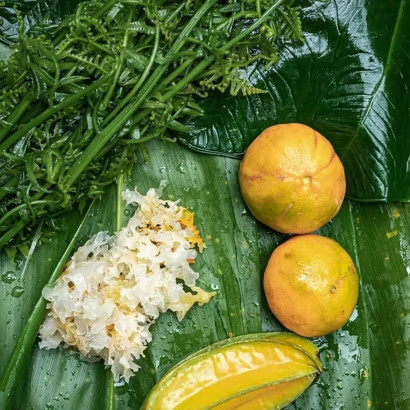
Hawaii feeds most of its people from 5,000 miles away. Over 80% of the food eaten here is imported. And the forests, shorelines, and valleys of these islands are packed with edible plants, wild mushrooms, and seasonal ingredients that have sustained people here for centuries.
Foraging in Hawaii is not a survival skill or a fringe hobby. It’s a way of re-learning how to see the land you’re standing on.
This guide is for people who are new to wild food and want to know how to start. What’s out there, how to approach it safely, and where to go deeper.
What Can You Actually Find Foraging in Hawaii?
More than you’d expect.
Hawaii’s forests are a layered mix of native plants and introduced species. Some of the introduced ones are among the most useful edible plants in the world. Here are the most accessible wild foods you’ll encounter:
Strawberry Guava (Psidium cattleyanum)
One of Hawaii’s most controversial plants. It’s invasive, it spreads aggressively, and environmentalists have been fighting it for decades. It’s also delicious. Strawberry guava produces small, intensely flavored red fruits throughout the year. They taste like a cross between a strawberry and a tropical guava. They make exceptional jams, fermented beverages, and sauces. Foraging it is an act of ecological service.
Wild Ginger (Hedychium species)
Also invasive, also incredibly useful. Wild ginger grows in dense stands in Hawaii’s moist forests, often taking over entire understories. The rhizomes are aromatic, spicy, and versatile. You can use them fresh, dried, fermented, or steeped into tea. Learning to identify and use wild ginger is one of the best entry points into foraging in Hawaii.
Kukui (Aleurites moluccana, Candlenut)
The kukui is Hawaii’s state tree. Its nuts were used as a light source, a cooking ingredient, and a medicine by Native Hawaiians for generations. The roasted nut is the base of inamona, the traditional condiment in Hawaiian poke. It’s one of the oldest cultivated plants in the Pacific.
Edible Mushrooms of Hawaii
Hawaii has a rich fungal ecosystem that most visitors and many residents never notice. Species like oyster mushrooms (Pleurotus spp.) and wood ear mushrooms (Auricularia spp.) grow on fallen logs in wetter forest zones. Seasonal flushes follow rain. Knowing where to look is most of the skill.
Hau (Hibiscus tiliaceus)
A coastal and lowland plant with edible flowers and young leaves. Hau is one of the most recognizable plants in Hawaii. It grows in dense thickets near water, with large yellow flowers that turn orange and red as the day goes on. The flowers can be eaten raw or cooked.
The Most Important Rule in Foraging
Positive identification before consumption. Always.
The same forests that hold extraordinary food also hold plants that can cause serious harm. The stakes are real, and identification is a learnable skill. It just takes time and repetition.
What you need before eating anything wild:
- Multiple confirming characteristics. Not just the shape of one leaf. The smell, the stem, the habitat, the season, the spore print for mushrooms, and ideally the agreement of someone who knows the plant well.
- A reference you trust. Field guides specific to Hawaii are valuable. So is local knowledge from people who have spent years in these forests.
- Time. Plant knowledge builds through repeated exposure, not a single outing. The more seasons you walk through, the more the forest makes sense.
Why Hawaii Is a Good Place to Learn Foraging
A few things make Hawaii’s wild food environment distinct.
Year-round growing season. There are no winters here. Fruiting, flowering, and mushroom seasons shift throughout the year, but something is always happening. You don’t have to wait for spring.
Biodiversity. Hawaii has one of the highest rates of endemic species in the world. Plants and fungi found nowhere else on earth. It also has a remarkable density of introduced tropical species, many with culinary and medicinal uses from their home cultures.
Cultural depth. Native Hawaiian relationships with wild plants go back more than a thousand years. That knowledge of lā’au lapa’au (plant medicine), traditional preparation methods, and ecological relationships is part of what makes foraging here more than a hobby. It connects you to a longer human story on this land.
Invasives are everywhere. A significant portion of what grows wild in Hawaii’s forests is introduced. Many of these plants are considered ecological problems. Foraging them regularly is one small way to participate in the land’s health.
How to Start Foraging in Hawaii
Start with one plant
Pick one species that grows abundantly near where you live or hike. Learn it completely. In every season, at every stage of growth. Learn what it looks like when it’s young, when it’s fruiting, when it’s dying. Learn what grows nearby that might be confused with it. Then eat it, cook with it, and pay attention to how it works.
This is slower than wanting to know everything at once. It’s also how real knowledge actually accumulates.
Get out on a guided walk
The fastest way to build plant knowledge is learning from someone who already has it. A good guide doesn’t just point at plants. They teach you how to see, what questions to ask, and how to build your own observation practice over time.
That’s what foraging classes in Oahu, Maui, and Kauai with Follow the Wai are built around. Small groups, hands-on time with real plants, and instruction from someone who has been in these forests for more than a decade.
Build a reference library
A few resources worth knowing:
- Plants of Hawaii by David Eickhoff, extensive photographic guide to Hawaiian flora
- Mushrooms of the Hawaiian Islands, specialist guide to local fungi
- iNaturalist, photograph a plant and get community identifications from botanists who know the region
Go slow. Be curious.
Foraging is a long game. The goal isn’t to identify everything on the first walk. It’s to build a vocabulary, slowly, that makes the land legible. After a few seasons in Hawaii’s forests, you stop walking past things. You start seeing meals.
Book a Foraging Class in Hawaii
The best way to begin is with a guide who has already spent years building the knowledge you’re looking for.
Follow the Wai offers guided foraging walks and wild food experiences on Oahu, Maui, and Kauai. Small groups, real forest time, and instruction from Chef Yuda Abitbol, who has been foraging Hawaii’s landscapes for over a decade.
Experiences start at $70/person and run about 3 hours. The full-day Forage & Feast adds an outdoor cooking session and a shared wild-food meal.
Yuda Abitbol is a Hawaiʻi-born chef and forager with 10+ years of plant knowledge. Follow the Wai offers guided foraging walks and wild food experiences on Oahu, Maui, and Kauai.